Online crime has affected the world wide web businesses and individuals since the initial appearance and spread of the Internet networks all over the world.
Internet services and websites make easy for us to pay bills, make online reservations, shop or even work remotely. And all these actions can take place from anywhere. Old boundaries and human limitations are dropped and we can have access to almost any online information, our lives becoming so much easier.
But the same is valid for CRIME.
Our freedom to navigate and access a large number of online locations represents our main vulnerability, because an open door always allows access in both directions.
Criminal minds can reach these days further than before, into our work offices and our homes. And there is little we can do about it.
The attack methods and tools vary from traditional attack vectors, which use malicious software and vulnerabilities present in almost all the programs and applications (even in the popular Windows operating systems) to ingenious phishing scams deployed from unexpected regions of the world, where justice can’t easily reach out to catch the eventual perpetrators.
The most common ways to become vulnerable to a malware attack or phishing scam take place when you:
We must not forget their final target is always our money and there is nothing they won’t do in accomplishing their mission.
These scams are based on phishing e-mails which try to persuade the victim to access a hacker controlled website by clicking a malicious link. In most cases, these phishing e-mails seem to be coming from official bank authorities, but if you click one of the links contained, you will be sent to a fake login access page which ressembles a real banking website.
The scammers usually do this by creating a frightening story of how your bank account is under threat and how you really need to access as soon as possible a web page where your credentials must be inserted in order to confirm your identity.
Of course, the provided link will only lead the potential victim to a fake web location and not to the real login page. When the online banking credentials are inserted in the fake online location, the hacker uses them to empty your real bank account later on.
It is one of the main techniques used in spreading financial and data stealing malware and there isn’t any reason why you shouldn’t be very well prepared for this attempt. But even if you install a good antivirus program and a specialized security software against this type of malware, there is no better way to stay safe from this threat, but by preventing the initial infection phase.
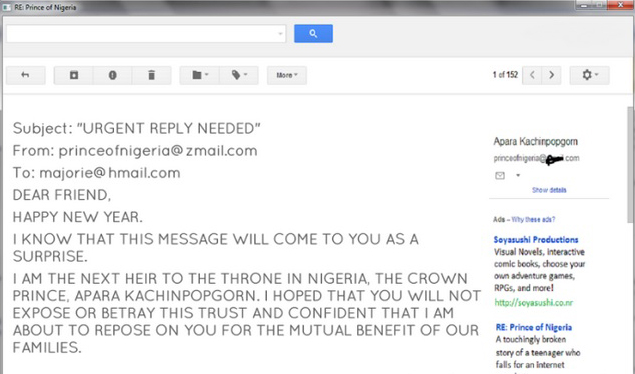
This money laundering scam – also known as the Nigerian scam – is a quite old scheme and most of us have already encountered it in a form or another in his own e-mail inbox.
Since it is an old scam, it has encountered multiple variations along the years. The typical scam starts when you receive an e-mail message where you are asked by an official government member, a businessman or the member of a wealthy family, usually a woman, to provide help in retrieving a large sum of money from a bank, paying initially small fees for papers and legal matters. For the services performed, you are promised a very large sum of money.
Of course, this is just the beginning. Eventually you are requested to pay more and more for other additional services, such as transactions, transfer costs, etc. You even receive papers that are supposed to make you believe that all this is “real“. In the end, you are left broke and without any of the promised money.
We have to mention here the cases where not only money were lost in the process, but sometimes people have been kidnapped or even worse.
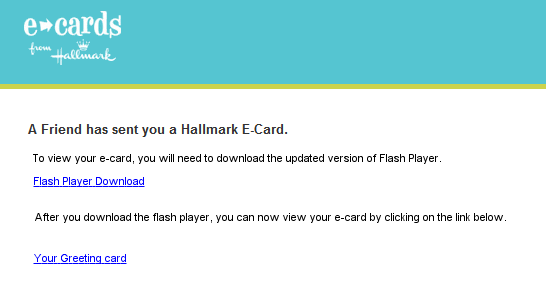
The greeting cards which arrive by e-mail in our e-mail inbox and pretend to be from a friend is again an old scam. If you open such an e-mail and click the card you are usually sent to a hacker controlled web location that downloads malicious software on your operating system.
The malicious software which downloads on your system may be an annoying program launching pop-ups and unexpected windows all over the screen, but it may also be one of the worst financial malware present around, a malicious software which could be part of the infamous Zeus family.
If your system becomes infected with such a dangerous malware, you will become one of the bots which are part of a larger network of affected computers. In this unfortunate event, your computer will start sending private data and financial information to a fraudulent server controlled by IT criminals.
To keep yourself safe from identity theft and data breach, we recommend using a specialized security program against this type of dangers.
To find out more information about financial malware, read this article.
Difficult times push people into getting trapped by “too good to be true” bank offers that guarantee large amounts of money and which have already been “pre-approved” by the bank.
If such an incredible pre-approved loan is offered to you, simply use your common sense and just think about it.
How is it possible for a bank to offer such a large sum of money without knowing your financial situation?
Though it may seem unlikely for people to get trapped by this scam, there are a number of people who lost a few hundred dollars by paying the “mandatory” processing fees required by the scammers.

One more classic scam which never seems to get old. The lottery scam comes as an e-mail message informing that you won a huge amount of money and all you need to do is pay some small fees before you can collect your fortune.
It doesn’t matter that you don’t recall ever purchasing lottery tickets.
Since it addresses some of our wildest fantasies, such as quitting our jobs and having fun for the rest of our lives without ever working again, our imagination easily falls pray to images of a dream house, endless summer vacations or expensive items a normal man can only imagine.
But the dream ends as soon as you find out you have been just another victim of this scam.

One of the most frequent scams you can meet online is the “hitman” extortion attempt, who sends an e-mail threatening the target in order to obtain money. This type of scam may come in various forms, such as the one threatening a family member, which can be kidnapped unless a ransom is paid in a time frame provided by the scammers.
To create the appearance of a real danger, the message is associated with numerous details from the potential victim’s life, collected from an onlineaccount, a personal blog or most frequently, from a social media account.

How many of us have already been fooled by this one? Since this one addresses our subjective self and not our rational side, we drop our guard and leave aside any logical analysis.
This scam takes place on social media sites, like Facebook, or by sending a simple e-mail to the potential target. The male scammers are often located in West Africa, while the female scammers are often based in Eastern parts of Europe.
IT criminals have used this method along the years by using online dating services and improved their approach by testing the potential victims’ reactions. This scheme or this game may take place for several months or more in order to gain the trust of that person. In many cases, it even goes to the moment when a meeting is arranged.
When this happens, two things may take place:
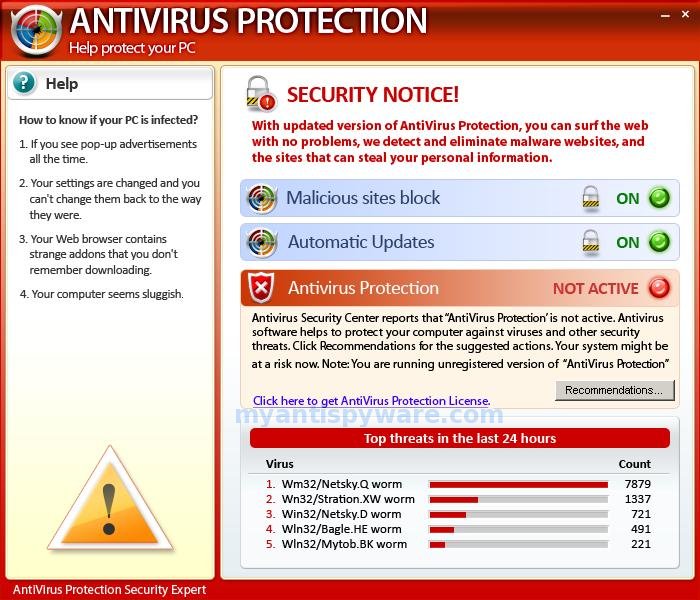
We all saw at least once this message on our screens: “You have been infected! Download antivirus X right now to protect your computer!”
Many of these pop-ups are very well created to be similar to an actual message you get from Windows or from a normal security product. If you are lucky, there is nothing more than an innocent hoax which will bother you by sending numerous unwanted pop-ups on your screen while you navigate online.
In this case, to get rid of the annoying pop-ups, we recommend scanning your system using a good antivirus product.
If you are not so lucky and you click one of the fake pop-up windows, malicious code, such as a Trojan or a keylogger can be downloaded on your system. This kind of message could come from one of the most dangerous ransomware threats around, such as CryptoLocker, which is capable of blocking and encrypting your operating system, requesting a sum of money in order to send you a decryption key.
To avoid this situation, we recommend using a specialized security product against this type of financial malware, besides your traditional antivirus program.
Facebook is today the most popular social media network. For this reason, important companies and businesses world wide use it in sending their correct message to customers and use it to promote their products. With so many friends and connections on this online platform, we use Facebook not only to check our friends’ activities and news, but also to chat, send and receive messages.
If most friends, colleagues and social connections are on Facebook, it is quite normal for such a place to attract also unwanted attention from online scammers.
Just imagine your account being hacked by an IT criminal and having access to your close friends and family.
Since it is so important for your privacy and online security, you should be very careful in protecting your personal online accounts and set a double authentication method as soon as possible. Using this method you make sure you add an additional layer of security, in this case your phone number.

Another common online scam is this popular method, used by cyber criminals, to make easy money by promising non-existent jobs, plans and methods of getting rich quickly and money from official government sources.
It is a quite simple and effective approach, because it simply addresses one’s basic need for money, especially when that person is in a difficult financial situation. From this point of view, this scamming method is similar to the Romance scam mentioned above, where the IT criminals address the romantic needs of the victim and then his financial means.
The fraudulent posting of non-existent jobs for a variety of positions is part of the online criminals’ arsenal.
Using various job types, such as work-at-home scams, the victim is lured into giving away personal information and financial data with the promise of getting a well paid job which can bring a lot of money in a very short period of time.
These scams usually appear in the hot summer months or during the short winter vacations, for Christmas or New Year’s Day. It takes place this way, you receive an e-mail containing an amazing offer for an extraordinary hard to get to destination, usually an exotic place, that expires in a short period of time and you must not miss.
The problem is that some of these offers actually hide some necessary costs until you pay for the initial offer and others simply take your money without sending you anywhere.
In these type of cases, we suggest that you study very well a travel offer and look for hidden costs, such as: airport taxes, tickets that you need to pay to access a local attraction, check if the meals are included or not, other local transport costs between your airport and the hotel or between the hotel and the main attractions mentioned in the initial offer, etc, etc.
Besides this, we suggest that you check if paying individually for plane tickets and for accommodation gives you the same results as in the offer you received. Sometimes, even if we pay more for a plane ticket to reach Asia from Europe or North America, you may be amazed at how cheap the accommodation costs can be compared to the rich Western countries..
For an extended list of common fraud schemes discovered and analyzed by FBI, check this article.
You may think that you can’t be fooled by these online scams, since some of them are quite hilarious, such as the one threatening you to send money or the one where scammers pretend to be FBI agents.
But some stories are so convincing for the potential victims that it is difficult to know how to deal with them.
Since some scams are so well organized and convincing, and the people behind so difficult to catch, that we need to acknowledge what are the most popular and successful online scams used against us and adapt our defenses accordingly.
Internet services and websites make easy for us to pay bills, make online reservations, shop or even work remotely. And all these actions can take place from anywhere. Old boundaries and human limitations are dropped and we can have access to almost any online information, our lives becoming so much easier.
But the same is valid for CRIME.
Our freedom to navigate and access a large number of online locations represents our main vulnerability, because an open door always allows access in both directions.
Criminal minds can reach these days further than before, into our work offices and our homes. And there is little we can do about it.
The attack methods and tools vary from traditional attack vectors, which use malicious software and vulnerabilities present in almost all the programs and applications (even in the popular Windows operating systems) to ingenious phishing scams deployed from unexpected regions of the world, where justice can’t easily reach out to catch the eventual perpetrators.
The most common ways to become vulnerable to a malware attack or phishing scam take place when you:
- shop online
- check your e-mail
- access social media networks
We must not forget their final target is always our money and there is nothing they won’t do in accomplishing their mission.
Phishing e-mail scams
These scams are based on phishing e-mails which try to persuade the victim to access a hacker controlled website by clicking a malicious link. In most cases, these phishing e-mails seem to be coming from official bank authorities, but if you click one of the links contained, you will be sent to a fake login access page which ressembles a real banking website.
The scammers usually do this by creating a frightening story of how your bank account is under threat and how you really need to access as soon as possible a web page where your credentials must be inserted in order to confirm your identity.
Of course, the provided link will only lead the potential victim to a fake web location and not to the real login page. When the online banking credentials are inserted in the fake online location, the hacker uses them to empty your real bank account later on.
It is one of the main techniques used in spreading financial and data stealing malware and there isn’t any reason why you shouldn’t be very well prepared for this attempt. But even if you install a good antivirus program and a specialized security software against this type of malware, there is no better way to stay safe from this threat, but by preventing the initial infection phase.
The money laundering scam
This money laundering scam – also known as the Nigerian scam – is a quite old scheme and most of us have already encountered it in a form or another in his own e-mail inbox.
Since it is an old scam, it has encountered multiple variations along the years. The typical scam starts when you receive an e-mail message where you are asked by an official government member, a businessman or the member of a wealthy family, usually a woman, to provide help in retrieving a large sum of money from a bank, paying initially small fees for papers and legal matters. For the services performed, you are promised a very large sum of money.
Of course, this is just the beginning. Eventually you are requested to pay more and more for other additional services, such as transactions, transfer costs, etc. You even receive papers that are supposed to make you believe that all this is “real“. In the end, you are left broke and without any of the promised money.
We have to mention here the cases where not only money were lost in the process, but sometimes people have been kidnapped or even worse.
Greeting Card scams
The greeting cards which arrive by e-mail in our e-mail inbox and pretend to be from a friend is again an old scam. If you open such an e-mail and click the card you are usually sent to a hacker controlled web location that downloads malicious software on your operating system.
The malicious software which downloads on your system may be an annoying program launching pop-ups and unexpected windows all over the screen, but it may also be one of the worst financial malware present around, a malicious software which could be part of the infamous Zeus family.
If your system becomes infected with such a dangerous malware, you will become one of the bots which are part of a larger network of affected computers. In this unfortunate event, your computer will start sending private data and financial information to a fraudulent server controlled by IT criminals.
To keep yourself safe from identity theft and data breach, we recommend using a specialized security program against this type of dangers.
To find out more information about financial malware, read this article.
A guaranteed bank loan or credit card scam
Difficult times push people into getting trapped by “too good to be true” bank offers that guarantee large amounts of money and which have already been “pre-approved” by the bank.
If such an incredible pre-approved loan is offered to you, simply use your common sense and just think about it.
How is it possible for a bank to offer such a large sum of money without knowing your financial situation?
Though it may seem unlikely for people to get trapped by this scam, there are a number of people who lost a few hundred dollars by paying the “mandatory” processing fees required by the scammers.
Lottery scam
One more classic scam which never seems to get old. The lottery scam comes as an e-mail message informing that you won a huge amount of money and all you need to do is pay some small fees before you can collect your fortune.
It doesn’t matter that you don’t recall ever purchasing lottery tickets.
Since it addresses some of our wildest fantasies, such as quitting our jobs and having fun for the rest of our lives without ever working again, our imagination easily falls pray to images of a dream house, endless summer vacations or expensive items a normal man can only imagine.
But the dream ends as soon as you find out you have been just another victim of this scam.
Hitman scam
One of the most frequent scams you can meet online is the “hitman” extortion attempt, who sends an e-mail threatening the target in order to obtain money. This type of scam may come in various forms, such as the one threatening a family member, which can be kidnapped unless a ransom is paid in a time frame provided by the scammers.
To create the appearance of a real danger, the message is associated with numerous details from the potential victim’s life, collected from an onlineaccount, a personal blog or most frequently, from a social media account.
Romance scams
How many of us have already been fooled by this one? Since this one addresses our subjective self and not our rational side, we drop our guard and leave aside any logical analysis.
This scam takes place on social media sites, like Facebook, or by sending a simple e-mail to the potential target. The male scammers are often located in West Africa, while the female scammers are often based in Eastern parts of Europe.
IT criminals have used this method along the years by using online dating services and improved their approach by testing the potential victims’ reactions. This scheme or this game may take place for several months or more in order to gain the trust of that person. In many cases, it even goes to the moment when a meeting is arranged.
When this happens, two things may take place:
- an “unpredictable” event occurs and the scammer needs money as soon as possible for his/her passport or other details.
- if the victim comes from a rich family, he/she may be kidnapped and a large sum of money could be requested from the family.
Fake antivirus software
We all saw at least once this message on our screens: “You have been infected! Download antivirus X right now to protect your computer!”
Many of these pop-ups are very well created to be similar to an actual message you get from Windows or from a normal security product. If you are lucky, there is nothing more than an innocent hoax which will bother you by sending numerous unwanted pop-ups on your screen while you navigate online.
In this case, to get rid of the annoying pop-ups, we recommend scanning your system using a good antivirus product.
If you are not so lucky and you click one of the fake pop-up windows, malicious code, such as a Trojan or a keylogger can be downloaded on your system. This kind of message could come from one of the most dangerous ransomware threats around, such as CryptoLocker, which is capable of blocking and encrypting your operating system, requesting a sum of money in order to send you a decryption key.
To avoid this situation, we recommend using a specialized security product against this type of financial malware, besides your traditional antivirus program.
Facebook impersonation scam (hijacked profile scam)
Facebook is today the most popular social media network. For this reason, important companies and businesses world wide use it in sending their correct message to customers and use it to promote their products. With so many friends and connections on this online platform, we use Facebook not only to check our friends’ activities and news, but also to chat, send and receive messages.
If most friends, colleagues and social connections are on Facebook, it is quite normal for such a place to attract also unwanted attention from online scammers.
Just imagine your account being hacked by an IT criminal and having access to your close friends and family.
Since it is so important for your privacy and online security, you should be very careful in protecting your personal online accounts and set a double authentication method as soon as possible. Using this method you make sure you add an additional layer of security, in this case your phone number.
Make money fast scams (Economic scams)
Another common online scam is this popular method, used by cyber criminals, to make easy money by promising non-existent jobs, plans and methods of getting rich quickly and money from official government sources.
It is a quite simple and effective approach, because it simply addresses one’s basic need for money, especially when that person is in a difficult financial situation. From this point of view, this scamming method is similar to the Romance scam mentioned above, where the IT criminals address the romantic needs of the victim and then his financial means.
The fraudulent posting of non-existent jobs for a variety of positions is part of the online criminals’ arsenal.
Using various job types, such as work-at-home scams, the victim is lured into giving away personal information and financial data with the promise of getting a well paid job which can bring a lot of money in a very short period of time.
Travel scams
These scams usually appear in the hot summer months or during the short winter vacations, for Christmas or New Year’s Day. It takes place this way, you receive an e-mail containing an amazing offer for an extraordinary hard to get to destination, usually an exotic place, that expires in a short period of time and you must not miss.
The problem is that some of these offers actually hide some necessary costs until you pay for the initial offer and others simply take your money without sending you anywhere.
In these type of cases, we suggest that you study very well a travel offer and look for hidden costs, such as: airport taxes, tickets that you need to pay to access a local attraction, check if the meals are included or not, other local transport costs between your airport and the hotel or between the hotel and the main attractions mentioned in the initial offer, etc, etc.
Besides this, we suggest that you check if paying individually for plane tickets and for accommodation gives you the same results as in the offer you received. Sometimes, even if we pay more for a plane ticket to reach Asia from Europe or North America, you may be amazed at how cheap the accommodation costs can be compared to the rich Western countries..
Conclusions
Online scams have developed using increasingly sophisticated means of deceiving users, especially in the known rich countries from the Western world. According to FBI, online scams have increased over the last 10 years and the total losses doubled in the recent years, affecting both private individuals and large scale businesses. For this reason, the cyber criminal activities are now subject to federal investigations and are treated as a very serious problem which affects us all.For an extended list of common fraud schemes discovered and analyzed by FBI, check this article.
You may think that you can’t be fooled by these online scams, since some of them are quite hilarious, such as the one threatening you to send money or the one where scammers pretend to be FBI agents.
But some stories are so convincing for the potential victims that it is difficult to know how to deal with them.
Since some scams are so well organized and convincing, and the people behind so difficult to catch, that we need to acknowledge what are the most popular and successful online scams used against us and adapt our defenses accordingly.

No comments:
Post a Comment